Easy Way To Make Money Online With a Website in 2026
Learn how to make money online by building a website, choosing a profitable niche, creating social media pages, and driving traffic with ads and content marketing.

Suggested:
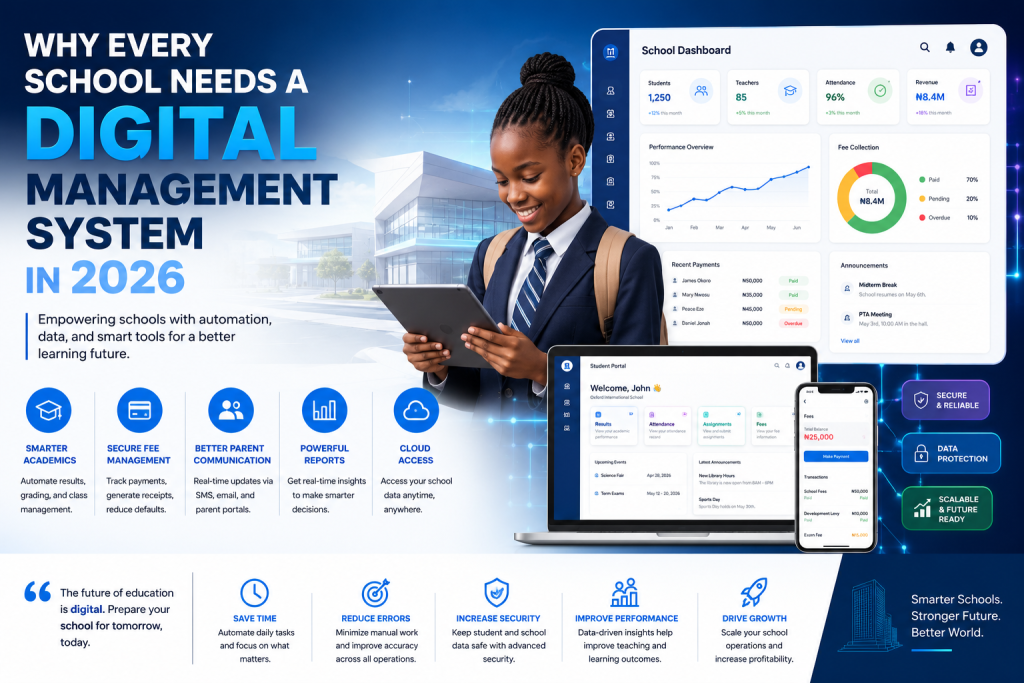
A detailed look at how digital school management systems are transforming education in 2026 by improving result management, fee tracking, communication, lesson planning, attendance, and overall school operations.
The education sector is changing rapidly. Schools that still rely heavily on manual processes are beginning to face serious challenges ranging from poor record keeping to communication delays, financial errors, and administrative stress.
In 2026, technology is no longer optional for schools. Parents expect faster communication, teachers want easier workflows, and school owners need better control over operations. This is why digital school management systems are becoming essential for modern education.
A digital management system helps schools automate daily activities such as attendance, result generation, fee payment tracking, lesson planning, report cards, communication, and staff management. Instead of handling everything manually, schools can manage operations from a centralized platform.
Table of contents [Show]
Many schools still use notebooks, spreadsheets, WhatsApp messages, and paper files to handle important records. While this method may work for very small schools, it becomes difficult to manage as the number of students increases.
Common problems schools face with manual systems include:
These issues waste time, reduce productivity, and sometimes damage the school’s reputation.
One of the biggest advantages of a digital school management system is automated result processing.
Instead of calculating scores manually, the system automatically computes totals, averages, grades, positions, GPA, and remarks instantly. This reduces human error and saves teachers countless hours every term.
Modern systems can also generate:
Parents also appreciate faster access to student performance.
Financial management is another major challenge for schools. Manual tracking often leads to incomplete records, disputes, and revenue leakage.
A good school management system allows schools to:
Some advanced systems even include QR receipt verification to help reduce fake receipts completely.
For school owners, this creates better accountability and financial transparency.
Communication is critical in education. Parents want updates about attendance, fees, results, assignments, and school activities.
A digital system makes communication easier through:
Instead of waiting for physical letters or meetings, parents can stay informed in real time.
Artificial Intelligence is now entering the education sector in powerful ways.
Modern school systems can now assist teachers by generating:
For example, a teacher can simply select:
And the system automatically generates:
This significantly reduces teacher workload while maintaining consistency.
Attendance tracking becomes much easier with digital systems.
Schools can:
This improves discipline and helps schools maintain proper records.
Data is important for growth. A digital management system provides valuable insights that help school owners make better decisions.
Administrators can instantly view:
Instead of guessing, school owners can use real data to improve operations.
Schools using modern systems appear more organized and professional.
Parents are more confident when they see:
Technology helps schools build trust and remain competitive.
In 2026, many schools are moving to cloud-based platforms.
Cloud systems allow schools to:
This flexibility is especially useful for schools with multiple branches.
Education is becoming more digital every year. Schools that refuse to adapt may struggle to meet modern expectations from parents, students, and staff.
A digital school management system is no longer just a convenience. It is now a necessity for efficiency, accuracy, growth, and long-term success.
Schools that embrace technology today will be better prepared for the future of education tomorrow.

Learn how to make money online by building a website, choosing a profitable niche, creating social media pages, and driving traffic with ads and content marketing.